
A NITI Aayog report indicates that India's digital public infrastructure (DPI) initiatives are projected to contribute significantly to the nation's GDP, potentially reaching 4 per cent by 2030.

India's services sector experienced its weakest growth in four-and-a-half years in July, as new business orders, both domestic and export, eased due to intense competition and declining demand. Despite a modest rebound in job creation and improved profit margins, overall business confidence slipped, reflecting a broader slowdown in the economy.
A NITI Aayog report indicates that India's digital public infrastructure (DPI) initiatives could contribute 4 per cent of the GDP by 2030, a significant increase from the current 1 per cent.

A joint study by IBM and IndiaAI, a MeiTY initiative, indicates that Artificial Intelligence (AI) has the potential to contribute over USD 500 billion to India's economy by 2030. The report highlights the need for improved AI literacy, infrastructure, and data quality to fully realise this potential.

Credit Suisse First Boston, a leading investment banker, has scaled down India's GDP growth from 5.7 per cent to 5.4 per cent for the financial year 2002-03.\n\n\n\n
Expressing optimism over the developments in the economy, Reserve Bank of India on Monday pegged the GDP growth for 2004-05 in the range of 6.5-7 per cent

Morgan Stanley believes that the factors responsible for the weak GDP growth include poor agricultural growth, weak investment trend, sluggish domestic market growth outlook and weakness in the service sector.

The Indian government is set to accelerate reforms, including measures to enhance foreign direct investment, speed up divestment, and boost asset monetisation, to maintain economic growth despite rising fuel and fertiliser import costs driven by the West Asia crisis.

Niti Aayog CEO Amitabh Kant said only farm revolution can make it possible. He also stressed on scrapping Agriculture Produce Marketing Committee and some old laws like Essential Commodites Act, which restrict movement of farm produces.

Moody's said fiscal measures undertaken by the government -- such as corporate tax rate cuts, bank recapitalisation, infrastructure spending plans, support for the auto sector and others -- do not directly address widespread weakness in consumption demand, which has been the chief driver of the economy. In addition, interest rate cuts by the Reserve Bank of India are not being adequately transmitted to lending rates because of the credit squeeze caused by disruption in the non-bank financial sector, it said.

Goldman Sachs has materially lowered its earnings growth forecast for Indian companies by a cumulative 9 percentage points over the next two years.

Foreign portfolio investors (FPIs) have injected Rs 30,919 crore into Indian equities in August, marking their second consecutive month of net buying. This follows a Rs 20,200 crore investment in July, indicating a potential reversal after four months of significant outflows, driven by improving corporate earnings, resilient economic activity, and a stable rupee.
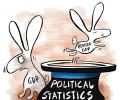
India Ratings and Research on Friday revised down India's FY22 real GDP growth forecast to 10.1 per cent, from earlier projection of 10.4 per cent, citing the second wave of COVID-19 infections and slower pace of vaccination. At a time when large parts of the country are experiencing tremendous pressure on medical infrastructure, the agency said it expects the second wave to start subsiding by mid-May. Earlier this month, the Reserve Bank maintained its 10.5 per cent GDP growth estimate, but Governor Shaktikanta Das has flagged the rising cases as the biggest impediment to recovery.

The fiscal deficit, as per the survey, deteriorated to 5.8 per cent of the GDP as compared to 3.4 per cent for 2018-19 estimated in the interim Budget.

India's services sector growth experienced a significant slowdown in June, reaching a 17-month low due to challenging market conditions and reduced domestic client interest, as indicated by the HSBC India Services PMI Business Activity Index.
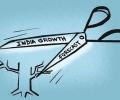
Fitch Ratings on Thursday slashed India's GDP growth projection for FY23 to 7 per cent, saying the economy is expected to slow against the backdrop of global economy, elevated inflation and high interest rate. In June, it had forecast 7.8 per cent growth for India. "We expect the economy to slow given the global economic backdrop, elevated inflation and tighter monetary policy. "We now expect the economy to grow 7 per cent in the financial year to end-March 2023 (FY23) from 7.8 per cent previously, with FY24 also slowing to 6.7 per cent from 7.4 per cent before," Fitch said in its September edition of the Global Economic Outlook.

S&P Global Ratings on Wednesday slashed India's GDP growth forecast for the current financial year to 9.8 per cent saying the second Covid wave may derail the budding recovery in the economy and credit conditions.

Professional forecasters have revised their projections for GDP growth in the current fiscal to 8.5 per cent from the earlier estimate of 8.4 per cent, according to a Reserve Bank of India survey.

The market breadth in BSE remained healthy with 1,905 shares advancing and 978 shares declining.

Foreign Portfolio Investors (FPIs) have withdrawn Rs 48,056 crore from Indian equities in October, driven by elevated crude oil prices, Middle East tensions, inflation concerns, and weak corporate earnings, though selling pressure moderated towards the end of the month.

The consumer price index (CPI)-based inflation hitting an all-time low in October would encourage the six-member monetary policy committee (MPC) of the Reserve Bank of India (RBI) to cut the policy repo rate in its upcoming December 3-5 meeting. However, the July-September GDP growth, expected to be above 7 per cent, may act as a deterrent.

Indian economy grew by 7.8 per cent in April-June -- the highest in five quarters -- before the disruptive US tariffs were imposed.

Former NITI Aayog vice-chairman Rajiv Kumar has urged the government to maintain zero-fee UPI transactions for several more years, arguing that the benefits of UPI as a public good outweigh the costs. This comes amidst the government's recent decision to introduce a 0.4% fee on person-to-merchant UPI transactions above Rs 2,000 from October 15, a move that has drawn criticism.
India's economic growth can reach a sustainable 10 per cent and be spread more evenly across the country if the government pursues ambitious and wide-ranging economic reforms, Organisation for Economic Cooperation and Development has said in a survey.
India's gross domestic product (GDP) growth during 2006-07 is estimated at 9.2 per cent as compared to 9 per cent during the previous year, advanced estimates of national income released by the Central Statistical Organisation say.

Bullish over robust fundamentals and improving macroeconomic conditions, industry leader Deepak Parekh on Saturday said India currently has "exceptionally good conditions" in place to aspire for 10 per cent economic growth but much needs to be done to achieve that target.
The PMEAC has revised economic growth rate upward to 7.1% for FY'12, up from 6.9% projected in advanced estimates.

The Indian economy is likely to grow at 7.4 per cent in 2025-26, up from 6.5 per cent in the previous fiscal, mainly on account of better performance of manufacturing and services sectors, as per the government data released on Wednesday.

The Centre has spent 28 per cent of its FY27 capital expenditure budget of Rs 12.21 trillion in the first three months against around 24.5 per cent during the corresponding period a year ago.

The slowdown in India is related to a credit squeeze, which is a cyclical problem - not a structural problem: American economist Steve Hanke.

India's manufacturing sector growth decelerated to a five-year low of 52.8 in August, down from 53.5 in July, as output and new orders moderated due to softer demand conditions, according to the HSBC India Manufacturing Purchasing Managers' Index (PMI).

India's net direct tax collection has surged by 13 per cent to over Rs 12.12 lakh crore by September 17 in the current fiscal year, driven by a significant increase in advance tax payments from corporates, according to CBDT data.

Finance Minister Nirmala Sitharaman on Tuesday said there were visible signs of revival in the economy but the GDP growth may be in the negative zone or near zero in the current fiscal.

With major sectors of the economy showing signs of slowdown, the list of those pegging India's economic growth at below eight per cent in the current financial year is expanding.

Improvements in industrial activity and services sector mainly seems to have boosted GDP growth.

'The real money in India over the coming period is likely to be made in small-cap stocks rather than in the large-cap benchmark names.'

India's total goods trade with BRICS nations more than doubled from FY21 to FY26, reaching USD 417.5 billion, but a significant surge in imports, particularly from China and Russia, has caused India's trade deficit with the bloc to more than triple, reaching USD 226.1 billion.

Moody's Ratings has downgraded India's growth forecast for financial year 2026-27 (FY27) to 6 per cent from 6.8 per cent, attributing the revision to weaker consumption and industrial activity, elevated energy prices, and rising input costs stemming from the West Asia conflict.
Setting the prescription for a 10 per cent annual economic growth, President A P J Abdul Kalam on Friday asked the Indian industry to sharpen its competitive edge to enhance its share in the global market.
Reserve Bank of India Governor, Y V Reddy presented the Monetary and Credit Policy for 2006-07 on Tuesday.
